The proposition is difficult to understand
Visitors have to work too hard to identify what the company offers, who it is for, and why it is credible.
 Start a project
 Service / 01
We plan and build websites around the work they need to do: explain a complex offer, generate demand, support customers, or deliver a digital service. The result is a fast, accessible platform your team can manage and extend.
Start a project
The business problem / 01
A website can look acceptable and still create commercial friction. The warning signs usually appear across several parts of the business at once.
Visitors have to work too hard to identify what the company offers, who it is for, and why it is credible.
Slow pages, unstable layouts, and poor mobile behavior make campaigns less effective and undermine confidence.
Simple updates depend on developers, the content model no longer fits, or duplicated pages have become difficult to govern.
New markets, integrations, products, or customer journeys expose limitations in the original structure.
What we do about it / 02
A focused review of objectives, audiences, content, analytics, competitors, and technical constraints.
Business reasonCreates a brief based on business priorities rather than assumptions.
A clear page, navigation, and content structure shaped around how people look for information.
Business reasonMakes important journeys easier to understand and maintain.
Responsive page systems, interaction patterns, and high-fidelity designs for the complete experience.
Business reasonConnects brand expression with usability and conversion intent.
Production-ready responsive implementation with accessible components and considered motion.
Business reasonProduces a consistent experience across screens and input methods.
A practical editing model using the CMS that best matches the publishing team and governance needs.
Business reasonGives internal teams control without sacrificing design quality.
Connection with CRM, forms, commerce, search, analytics, authentication, and other business systems.
Business reasonReduces disconnected workflows and avoids unnecessary manual handling.
How we work / 03
Clarify objectives, audiences, current performance, content realities, technical constraints, and the decisions the website must support.
Set priorities, information architecture, content model, technical direction, scope, and a delivery plan the team can trust.
Design the responsive system, develop reusable components, connect content and integrations, and review in working increments.
Use observed behavior, search data, feedback, and commercial priorities to shape the next valuable improvements.
Tools and technology / 04
Technology is selected after the content, operating model, integrations, and expected lifespan are understood. A simpler stack is often the better decision.
Why YANY SOUL / 05
We start with the role the website plays in the business, then choose the architecture and tools. Design, content, development, measurement, and maintainability operate as one system, not separate handoffs.
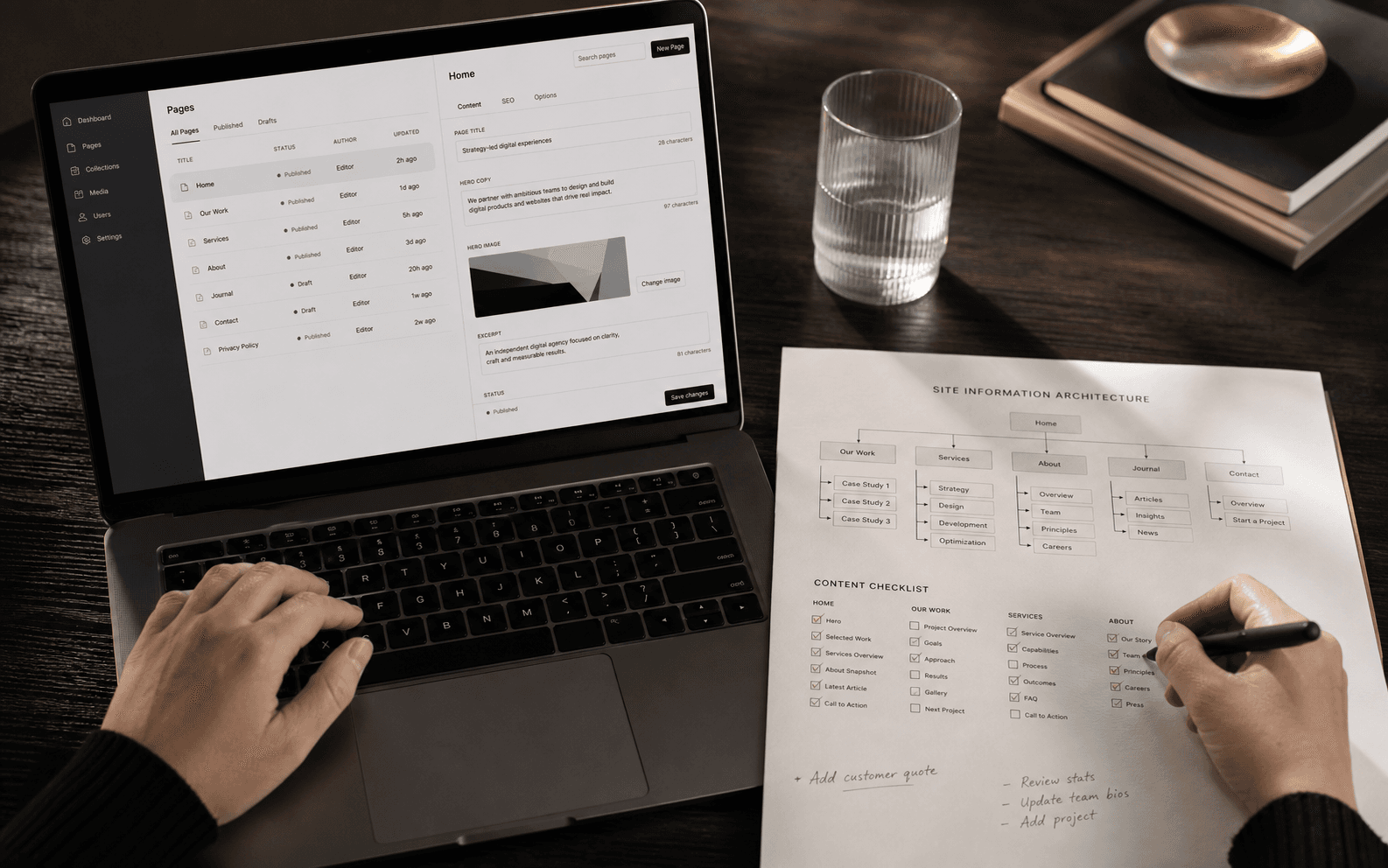
Relevant work / 06
Strategy · Website Design · Development
Representative concept work. Client identity and verified outcome data have not been supplied.
View representative case studyTiming depends on scope, content readiness, integrations, and stakeholder availability. A focused marketing site may take several weeks; a complex platform can take several months. We establish the delivery plan after discovery rather than offering an unreliable universal estimate.
Yes. We review what should be kept, improved, consolidated, or retired. That includes valuable content, URLs, analytics history, and existing integrations. We then redesign the experience.
Yes. WordPress can be a sensible choice when editorial familiarity and flexible publishing are priorities. We also work with modern headless and application frameworks when the requirements justify them.
Yes. We design and develop portals, dashboards, workflow tools, authenticated products, and API-connected experiences. The discovery phase defines the users, permissions, data, and operational requirements first.
Responsive behavior is designed and tested as part of the core work, not added at the end. Content priority, navigation, forms, touch targets, image behavior, and performance are considered across screen sizes.
Next / Start a project
Share what needs to change, what the business needs from it, and where the current experience is getting in the way.
Start a project